
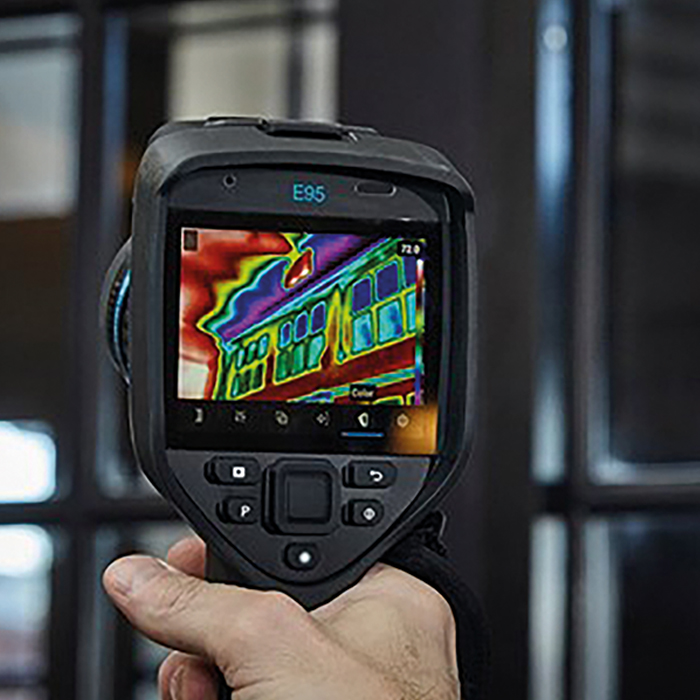

From commercial skyscrapers to industrial manufacturing plants to data centers, critical facilities must maintain a safe and secure environment for optimal operation.
To meet this need, more building teams are deploying thermal cameras to enhance intrusion detection at the perimeter as well as to streamline elevated skin temperature screening at entry points. Today, facility directors are also increasingly using thermal cameras for building diagnostics to detect problems and proactively resolve issues for preventive maintenance.
Without tools to quickly diagnose building issues, they remain hidden and escalate in severity. A misaligned Heating Ventilation and Air Conditioning (HVAC) duct can result in air leaks that blow excessive heat into an office space, creating a highly uncomfortable working environment for employees. A clogged or broken pipe in a plumbing system left untreated can cause water leaks and mold. A loose or hot electrical connection can lead to heat buildup that causes a circuit failure and power outage. All of these scenarios lead to system downtime, business disruption, and financial losses. This is why it is so important for facility managers and maintenance teams to detect issues prior to failure and leverage technologies that keep building systems running smoothly.
While an air leak, water intrusion, or overloaded circuit may not be visible to the naked eye, these issues are clearly visualized with thermal technology. All objects emit radiation, or put simply, heat. Thermal sensors measure the heat signatures of all objects and reflect the minute differences in images. Taking it a step further, radiometric thermal cameras yield images that show temperature values.
When it comes to surveying building systems using thermal or infrared technology, there are two common options for inspectors: infrared thermometers and radiometric handheld thermal cameras. IR thermometers are cost-effective options that yield a temperature measurement of a single surveyed spot. Radiometric thermal cameras yield temperature measurements across thousands of spots. This is because each pixel in a radiometric thermal image provides a temperature measurement, providing a much more extensive and holistic understanding of the surveyed area.
Consequently, inspectors opt for radiometric handheld thermal cameras time and time again for their many benefits. First, these thermal cameras yield greater scanning coverage, which leads to faster detection. Thermal cameras are a non-contact screening tool, which allows inspectors to monitor energized equipment, like live electrical components, from a safer distance. Yielding detailed imagery, thermal cameras offer a more comprehensive view of a problem. These thermal images serve as evidence to substantiate a diagnosis as well as verify that an issue was fixed, enhancing credibility for inspectors as well as quality assurance. Thermal cameras also act as a differentiating tool, distinguishing well-equipped inspectors from other contractors.
For more information visit:
www.flir.co.uk
