
 Philip Heine from T Cards Direct explains why many companies go for a simple approach to coordinating Engineering Staff and Health & Safety
Philip Heine from T Cards Direct explains why many companies go for a simple approach to coordinating Engineering Staff and Health & Safety
Following the UK's departure from the European Union, manufacturers supplying explosion-protected equipment to both Great Britain and the European Union must ensure they understand the differences between the UKEX and ATEX regulatory frameworks. While the technical standards remain closely aligned, the conformity assessment and product marking requirements differ depending on the destination market.
UKEX is the conformity marking required for products placed on the market in Great Britain (England, Scotland and Wales). It applies to equipment and protective systems intended for use in potentially explosive atmospheres under the Equipment and Protective Systems Intended for Use in Potentially Explosive Atmospheres Regulations 2016, as amended following Brexit.
Although UKEX is based on the same essential health and safety requirements as the ATEX Directive, products destined for Great Britain must follow the UK conformity assessment process where applicable.
Manufacturers supplying equipment to EU member states must continue to comply with the ATEX Directive 2014/34/EU and apply the CE and Ex markings where required.
The technical standards supporting both UKEX and ATEX are largely harmonised with the IEC 60079 series, meaning the engineering requirements remain familiar to manufacturers. However, the administrative route to market differs.
Manufacturers should be aware of several important distinctions:
Many manufacturers continue to serve customers in both Great Britain and the European Union. Planning certification early can help minimise duplication, reduce costs and avoid delays when launching new explosion-protected equipment.
By understanding the differences between UKEX and ATEX, manufacturers can ensure their products remain compliant while maintaining access to key industrial markets.
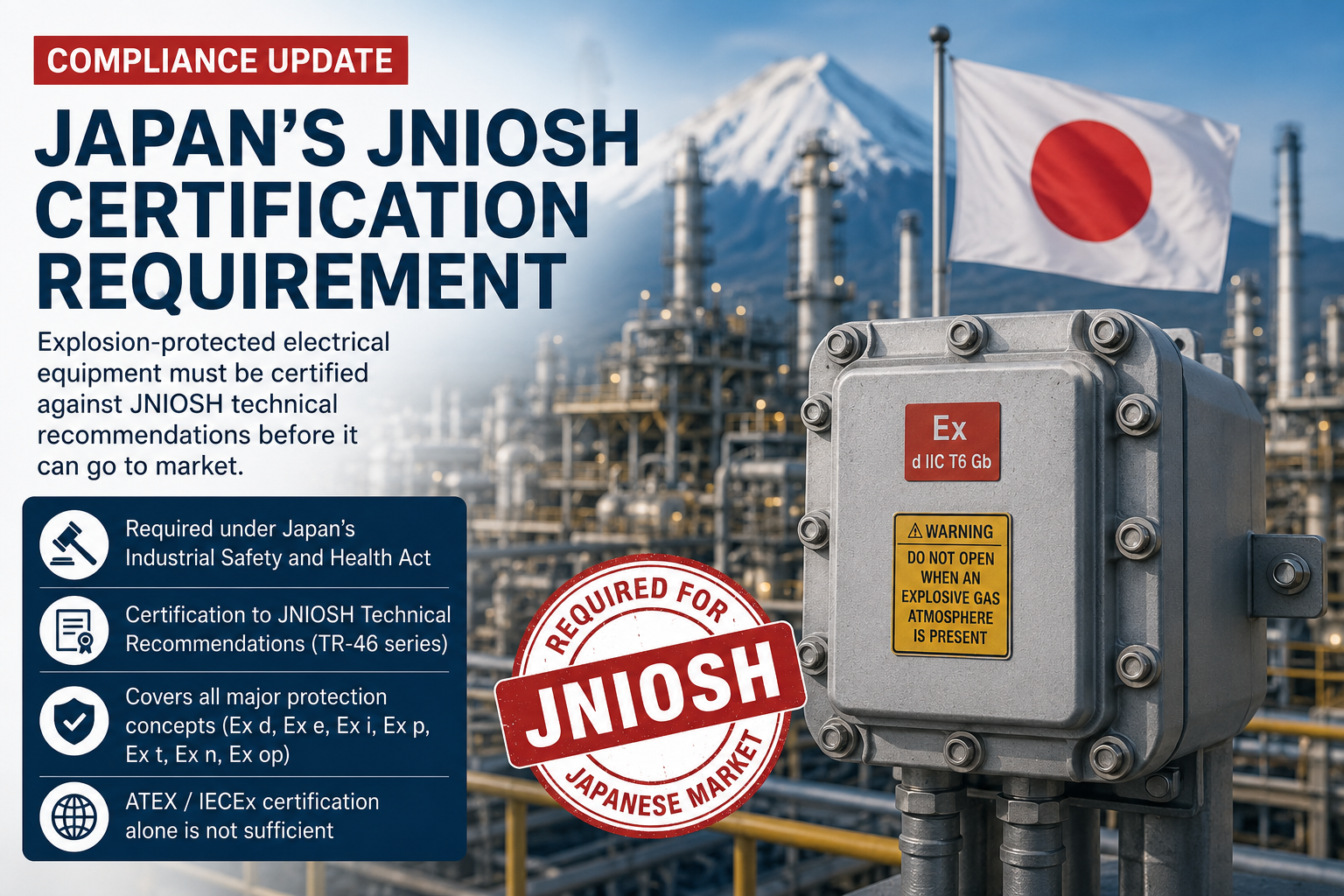
Under Japan's Industrial Safety and Health framework, explosion-protected electrical equipment intended for use in hazardous locations must comply with the country's Technical Recommendations issued by the National Institute of Occupational Safety and Health (JNIOSH). In many cases, products require certification against these recommendations before they can be legally placed on the Japanese market.
While Japan's technical requirements are closely aligned with the IEC 60079 series used internationally, manufacturers cannot simply rely on existing ATEX or IECEx approvals alone. Certification must demonstrate compliance with the applicable JNIOSH Technical Recommendations, which form the basis of Japan's national approval process for explosion-protected equipment.
The recommendations cover the various recognised methods of explosion protection, including:
These guidance documents are regularly updated to reflect developments in international standards while maintaining Japan's specific regulatory requirements.
Japan remains one of the world's largest industrial economies, with significant investment across:
For overseas manufacturers, understanding the country's certification pathway early in the product development process can prevent costly delays when entering the market.
Manufacturers intending to export explosion-protected equipment into Japan should review certification requirements at an early stage. Working with certification specialists familiar with both IECEx/ATEX and JNIOSH requirements can help streamline approval and ensure products meet the necessary technical and quality standards expected by Japanese regulators.
Although many technical principles are harmonised with international standards, Japan's certification process remains distinct, making regulatory planning an important part of any successful market entry strategy.
As hazardous industries continue to expand across Asia, understanding regional certification requirements is becoming increasingly important for manufacturers seeking to operate in global markets.
The International Electrotechnical Commission (IEC) has officially published IEC 60079-0:2026 Edition 8, introducing the latest revision of the core international standard governing the design, construction, testing and marking of equipment intended for use in explosive atmospheres.
The publication of IEC 60079-0:2026 Edition 8 marks an important milestone for manufacturers, certification bodies and end users operating in hazardous environments.
As the cornerstone standard covering the general requirements for equipment intended for use in explosive atmospheres, IEC 60079-0 underpins many of the protection concepts used across ATEX and IECEx certified equipment. The release of Edition 8 introduces a number of technical revisions designed to improve clarity, consistency and safety throughout the equipment lifecycle.
While many of the changes are aimed at equipment manufacturers and certification organisations, there are also important implications for operators, maintenance teams and hazardous area professionals responsible for selecting, installing and maintaining Ex equipment.
One of the key changes in Edition 8 is an increased emphasis on ensuring that equipment markings, documentation and specified conditions of use are fully understood and followed throughout the equipment's operational life.
For end users, this reinforces the importance of:
Although existing certified equipment remains valid under the terms of its certification, organisations planning new projects or equipment upgrades should be aware that newly certified products will increasingly reference IEC 60079-0:2026 Edition 8.
The updated standard forms part of the ongoing development of the IEC 60079 series, helping to ensure that explosion-protected equipment continues to meet the evolving needs of modern industrial facilities.
For manufacturers, the new edition provides updated technical requirements for product design, testing and certification. For users, it serves as a timely reminder that correct equipment selection, installation and maintenance remain fundamental to maintaining safety and compliance within hazardous locations.
Companies operating in sectors such as oil & gas, chemical processing, pharmaceuticals, hydrogen, energy, mining and manufacturing should familiarise themselves with the latest edition and consult their certification partners where appropriate when specifying new Ex equipment.
As manufacturers begin introducing products certified to IEC 60079-0:2026 Edition 8, hazardous area professionals can expect to see the new standard referenced more frequently across technical documentation and certification records.
Tags:
Updated: June 2026
This article reflects the publication of IECEx 02 Edition 9.0, released on 25 March 2026.
The IECEx System has introduced Edition 9.0 of its Certified Equipment Scheme Rules of Procedure, bringing several important updates for manufacturers, certification bodies and organisations involved in the design and supply of equipment for explosive atmospheres. While the fundamental principles of IECEx certification remain unchanged, the latest edition reflects the continued evolution of international standards and certification processes.
As industries such as hydrogen, battery energy storage, oil & gas, chemicals and pharmaceuticals continue to expand, demand for internationally recognised hazardous area certification continues to grow. The publication of IECEx 02 Edition 9.0 demonstrates the scheme's ongoing commitment to maintaining globally harmonised certification procedures while supporting technological advances and regulatory developments.
The IECEx System is the International Electrotechnical Commission's conformity assessment system for equipment and services used in explosive atmospheres.
Unlike ATEX, which is a legal requirement within the European Union, IECEx is an international certification scheme recognised by many countries around the world. It provides confidence that equipment has been independently assessed against the internationally accepted IEC 60079 standards.
Today, IECEx certification is widely used throughout:
For companies exporting equipment internationally, IECEx certification can significantly simplify market access.
The publication of IECEx 02 Edition 9.0 represents the latest revision of the Rules of Procedure governing the IECEx Certified Equipment Scheme.
The updated edition introduces refinements aimed at improving consistency across certification bodies, strengthening governance arrangements and reflecting changes introduced through revised IEC standards.
Among the key areas addressed are:
Although many of the changes are procedural rather than technical, they help maintain the credibility and international recognition of IECEx certification.
For manufacturers, compliance with the latest IECEx procedures helps ensure certification remains recognised throughout global markets.
Certification bodies also benefit from clearer procedures that improve consistency when assessing products against the IEC 60079 standards.
Ultimately, end users gain increased confidence that certified equipment has been assessed using harmonised international processes.
One of the biggest drivers behind continued IECEx development is the rapid growth of emerging technologies.
Hydrogen infrastructure, battery energy storage systems, carbon capture facilities and renewable energy projects all present new hazardous area challenges.
As these industries expand, manufacturers increasingly require certification that is recognised internationally rather than being limited to one geographical region.
IECEx continues to play a central role in supporting these developments.
The IECEx Scheme is built around the internationally recognised IEC 60079 series of standards.
These standards cover every aspect of explosion protection, including:
As these standards evolve, the IECEx Scheme is updated to ensure certification processes remain aligned with current technical requirements.
Companies manufacturing equipment for explosive atmospheres should review the latest IECEx documentation and ensure internal certification processes remain aligned with current requirements.
Although existing certificates remain valid where appropriate, organisations planning new product approvals should work closely with their certification body to understand any procedural changes introduced through Edition 9.0.
Maintaining awareness of evolving IEC standards will also help reduce delays during future certification projects.
International demand for explosion-protected equipment continues to increase, particularly within hydrogen, renewable energy and advanced manufacturing sectors.
The publication of IECEx 02 Edition 9.0 reinforces the scheme's position as one of the world's leading certification systems for equipment used in explosive atmospheres.
For manufacturers seeking global market access, staying informed about these developments will remain an important part of successful product certification strategies.
Where and how equipment is intended to be used
The hazardous zones and atmospheres it is suitable for
Any limitations or exclusions
Incorrect or incomplete Declarations of Conformity
Inaccurate or misleading Ex markings
Missing or insufficient technical documentation
Equipment placed on the market without appropriate conformity assessment
Ignition risk assessments
Temperature classification and surface temperature data
Alignment with harmonised standards such as the EN / IEC 60079 series
Consistency between certificates, manuals, labels, and marketing material
Hydrogen production, storage, and distribution equipment
Wireless and IIoT devices used in hazardous areas
Battery-powered and mobile equipment
Software-enabled safety functions and monitoring systems
Clear definition of intended use
Robust and complete technical documentation
Correct marking and certification routes
Alignment between product design, manuals, and marketing claims
Why This Matters
For businesses operating in hazardous environments, compliance with ATEX, UKCA, and UKEX regulations is critical. Since Brexit, the regulatory framework has evolved, creating both challenges and opportunities for manufacturers, suppliers, and end-users. This article outlines the 2025 situation—what’s confirmed, what’s changing, and what to watch out for.
From January 2021, products intended for explosive atmospheres in Great Britain must comply with the UKEX scheme, under the umbrella of UKCA marking. Conformity assessments are carried out by UK Approved Bodies, under the amended Equipment and Protective Systems Intended for Use in Potentially Explosive Atmospheres Regulations 2016.
The UK government now recognises CE-marked goods indefinitely in many categories, including Ex equipment. This provides flexibility for manufacturers already holding ATEX certificates, as their products can continue to be placed on the GB market without immediate retesting. However, conditions apply, particularly around certificate expiry dates and product modifications.
Transitional easements mean UKCA/UKEX marks and importer details can be shown on packaging or accompanying documentation rather than directly on products. These easements have been extended, with some lasting until 2025 and others to 2027. Spare parts used to maintain existing systems can still be covered under earlier compliance approvals.
A major area of uncertainty remains around what qualifies as a “substantial change” to a product. Minor updates may not require new certification, but significant modifications could trigger the need for fresh UKEX assessment. Clearer guidance is still awaited.
UK Approved Bodies are now issuing UKEX certificates. In certain cases, conformity assessments completed by EU Notified Bodies before cut-off dates can still be used for UKEX purposes, helping manufacturers avoid duplicate testing. Careful tracking of certificate validity and evolving standards is essential.
While UKEX/UKCA applies in Great Britain, Northern Ireland continues under EU rules, requiring CE marking (and sometimes UKNI marking). Businesses trading across GB, NI, and EU markets need to manage dual-marking and certification carefully.
Enforcement remains a developing area. Authorities are expected to step up checks on compliance, but feedback suggests consistency still varies by product category.
As of 2025, the key takeaway is that CE marking remains valid indefinitely in many cases, but UKEX certification is the long-term framework for explosive atmosphere equipment in Great Britain. Companies should:
Monitor certificate expiry dates carefully.
Use CE/ATEX certification where accepted, but prepare for UKEX transition.
Stay alert to new announcements from UK government, OPSS, and Approved Bodies.
At Hazardous Engineering Solutions and Engineering Maintenance Solutions, we track every regulatory update that impacts hazardous areas and maintenance professionals.
👉 For the latest ATEX / UKCA / UKEX insights, event previews, and compliance news, visit www.hazeng.com
The Requirements for ATEX/UKCA
One of the most misunderstood aspects of ATEX and UKCA Ex Certification is the ‘blend’ of Self Certification and Notified/Approved Body Certification. There are many routes to certification, and this is explained in legislative documents, but for end users and manufacturers it can be very confusing. An example of the routes to conformity is shown below….
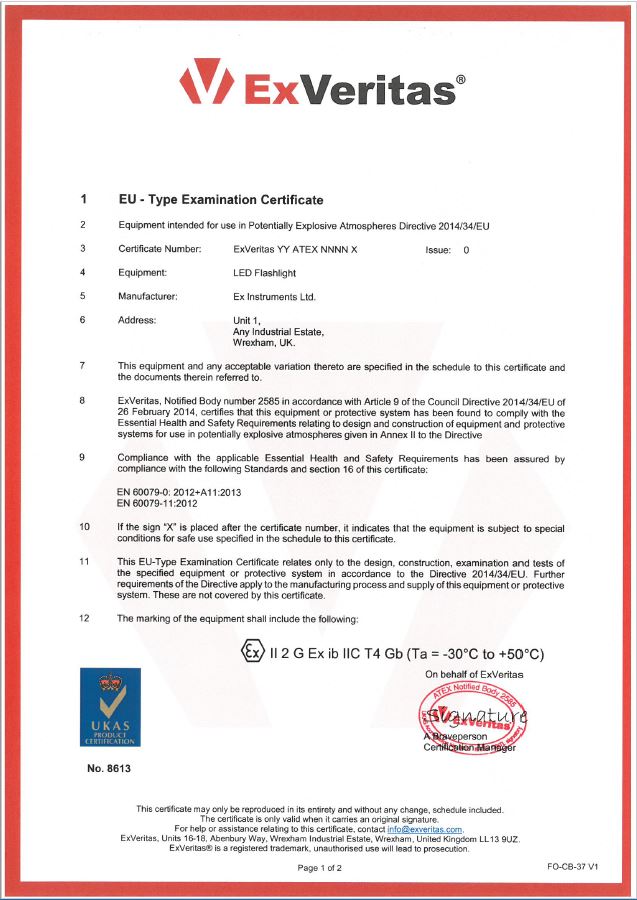
So what exactly does this mean?
It is also worth noting that electrical products which are certified as a ‘component’ (a ‘U’ on the end of the certificate number) requires recertification by a Notified/Approved body before they can be used in a potentially explosive atmosphere for CAT 1 and CAT 2.
Equipment Manufacturers Self Declaration (commonly referred to as ‘Self Certification’)
Manufacturers ‘Self Declaration’ under CE or UKCA Marking makes the person who signs the ‘declaration’ legally responsible for the equipment compliance as there is no legal requirements for 3rd party certification and no quality control over what is produced other than internal control of production. Regulatory Authorities may request the evidence (for example clause by clauses standards assessment and test reports) for the standards claimed on the Declaration.
Category 3 Electrical and Category 2 and 3 Non-electrical can be voluntarily certified (and this is sometimes required by end users/buyers) in the following ways…
The Requirements for IECEx
IECEx always requires a fully accredited and regulated ‘IECEx Certification Body’ to issue the certification, there is no self certification route. All IECEx Certificates also control the manufacturing quality related aspects via an IECEx QAR.
It’s easy to see why IECEx has become the ‘international’ scheme and why many end users prefer the simplicity and control of an IECEx Certificate. It should be noted however that although IECEx is the ‘baseline’ for most international schemes (including UKCA and ATEX), National Certification is normally required ‘in addition’ to the IECEx Certification, but the process should be far simpler than achieving multiple National Certification that may not be accepted in other countries…
Sean Clarke CEng MSc FIET is the Managing Director of ExVeritas who a UKCA Approved ‘Ex’ Body, an ATEX Notified Body and IECEx Test and Certification Body. With ‘Ex’ test laboratories in the UK and USA. www.exveritas.com
Happy 2023! I thought as it was anew year I would take a break from updating everyone on the every changing UKCA Requirements and look at a few other scheme and Standards updates.
The IECEx Certified Equipment Scheme have published OD 290 - Harmonized procedures for IECEx certification of equipment, components and systems associated with the production, dispensing and use of gaseous hydrogen.

IEC TS 60079-46 is for the certication of ‘assemblies’ and can be applied to any combination of certified equipment from diesel skids to pump sets. Assembly Certification gives end users confidence that the package they have had delivered are assessed by a 3rd party and simplifies the marking of the overall package. IEC TS 60079-46 is required for IECEX Assembly Certification but can also be used as the basis for ATEX and UKCA Approval if requested.
Purge and Intrinsic Safety Standards Update
Just to note there have been major updates to the Purge and Pressurization Standard and the new Intrinsic Safety Standard (which has just been published). These are very significant updates with approximately 40 major technical changes in each so will need to be considered carefully by manufacturers who use these concepts.
Sean Clarke CEng MSc FIET is the Managing Director of ExVeritas Limited.
ExVeritas provides Product Certification, Management System Certification, CompEx Certification and Site Safety Services and are a UK Government Appointed Body for UKCA ‘Ex’, an ATEX Notified Body and an IECEx Certification Body and Test Laboratory
Article written by Sean Clarke
Managing Director for Exveritas

From 1 January 2023, equipment and protective systems intended for the GB market should be conformity assessed by a UK approved body where necessary and should be UKCA marked, not CE marked.
All new products that placed on the market previously would have needed an ATEX Notified Body certificate will need a UKCA Ex Approved Body Certificate (and QAN as applicable)
On 20 June 2022 however the Government announced it intends to introduce legislation which will allow completed conformity assessment activities carried out under EU requirements before 1 January 2023 to permit self-declaration under certain conditions for a limited period. It should be noted however that this legislation has not yet been passed so anyone considering this route is doing so under their own risk. It is planned for the proposed legislation change to be placed before Parliament in the autumn 2022 to give effect to this.
The proposed legislation change will permit ATEX Notified body Certificates issued before 1 January 2023 to be used by manufacturers to declare existing product types as compliant with UKCA (assuming the ATEX Certificates are to the relevant UKCA Designated Standards)
Products must still bear UKCA marking. For ongoing production, they will need to undergo conformity assessment with a UK Approved Body once any of the relevant certification has changed (for example with a variation to the EU-Type examination certificate after 1 January 2023 or the QAN expiring), or after 5 years (31 December 2027), whichever is sooner. This will allow manufacturers to apply the UKCA mark without the need for UK approved body involvement and continue to place their goods on the GB market, based on an existing EU type examination certificate issued before 31 December 2022.
Where manufacturers are using existing ATEX certification completed before 1January 2023 as the basis to demonstrate compliance with UKCA for their products, they should include in the UK Declaration of Conformity the list of relevant UK designated standards and equivalent EU harmonised standards that apply to their product, as well as details of the ATEX Notified Body which carried out the conformity assessment procedures.
If the ATEX certificate was not issued before 1 January 2023, or a variation is issued to that certificate after that date then these products are considered ‘new’ and would require certication by an UKCA Ex Approved Body. This is also the case when the products are manufactured under an ATEX QAN, when the QAN expires the product will require a UKCA QAN issued by a UKCA Ex Approved Body.
Please note that whist this guidance is derived from published UK Government documents and feedback from BEIS, interpretations and legislation may change again before the end of the year!
Sean Clarke CEng MSc FIET is the Managing Director of ExVeritas who a UKCA Approved ‘Ex’ Body, an ATEX Notified Body and IECEX Certification Body.